
Ready to Start Your Wellness Journey?
Become a Herbalife Preferred Member and enjoy exclusive discounts of up to 25% on all products.
BECOME A PREFERRED MEMBERMeal Replacement Drinks for Weight Loss: A Complete Guide
If you have ever stood in the kitchen at 7am holding a coffee, knowing you should eat something but having no time to cook, you already understand why meal replacement drinks exist. They turn the hardest part of weight loss — eating the right amount of the right thing on a busy day — into a 30-second decision.
This guide answers the questions people actually search before they buy: do they work, how do you use them, what is in a good one, and what mistakes kill results. It is written from the angle of a Herbalife independent distributor who has watched real customers get real outcomes — not a brand pitch and not a generic round-up.
What a meal replacement drink actually is
A meal replacement drink is a beverage formulated to deliver, in one serving, the macronutrients (protein, carbohydrates, some fat) and micronutrients (vitamins and minerals) you would expect from a balanced meal. Unlike a protein shake, which targets one nutrient, a meal replacement is built to stand in for a whole meal — both nutritionally and in terms of how full it leaves you.
The category includes shakes, ready-to-drink bottles, and powders you mix with water or milk. Quality varies a lot. A grocery-aisle "diet shake" with 90 calories and 5 grams of protein is not the same product as a 220-calorie 17-gram-protein shake formulated for daily use. The label tells you which kind you have.
The science behind why they work for weight loss
Weight loss happens when you take in fewer calories than you burn over time. That sounds simple, and on paper it is. The hard part is doing it consistently for months. Meal replacement drinks help in three measurable ways:
- They remove decisions. A breakfast shake is one decision. Choosing breakfast from scratch every morning is dozens. Decision fatigue is one of the quiet reasons diets fail.
- They control portion size automatically. The serving size is fixed. There is no chance of pouring more than you intended.
- They deliver enough protein to keep you full. Higher-protein meals reduce hunger between meals. Most homemade quick breakfasts (toast, cereal, pastry) are low in protein.
Clinical research consistently finds that meal replacement programs produce more weight loss than equivalent calorie-restricted diets that rely entirely on conventional food, mostly because adherence is easier when one or two meals are pre-defined.
What a quality meal replacement looks like
Read the nutrition panel before you buy. A shake worth using daily for weight loss usually meets all of these:
- 200–250 calories per serving when prepared as directed (often with milk or a milk alternative).
- 15–25 grams of protein. Lower than that and you will be hungry by mid-morning.
- 3 grams of fiber or more. Fiber slows digestion and supports gut health.
- 20–30% of daily vitamins and minerals across a wide micronutrient profile.
- Low added sugar — under about 10 grams per serving, depending on the size.
- An ingredient list you can read. Recognizable plant-based ingredients and quality protein sources.
If a product is missing two or three of these markers, it is probably a snack drink, not a meal replacement. Use it that way and weight will not move.
The simplest way to use a meal replacement for weight loss
The pattern that works for the largest number of people is the simplest:
- One meal replacement at breakfast. The meal you are most likely to skip or eat poorly. Replacing it sets a positive baseline for the day.
- One meal replacement at lunch or dinner. Pick the meal where your environment makes a healthy version hard — the takeout-prone lunch or the late-night dinner.
- One balanced cooked meal. Vegetables, lean protein, and a controlled portion of starch. This is the meal where you actually enjoy food.
- Two snacks of fruit, nuts, or yogurt. Real food, ~100–150 calories each, to keep blood sugar steady.
- Plenty of water. Most people undershoot hydration when they are losing weight; aim for at least 2 liters a day.
That is roughly a 1,400 to 1,700 calorie day for an average adult, with 70 to 100 grams of protein. Sustainable, simple, and almost impossible to mess up.
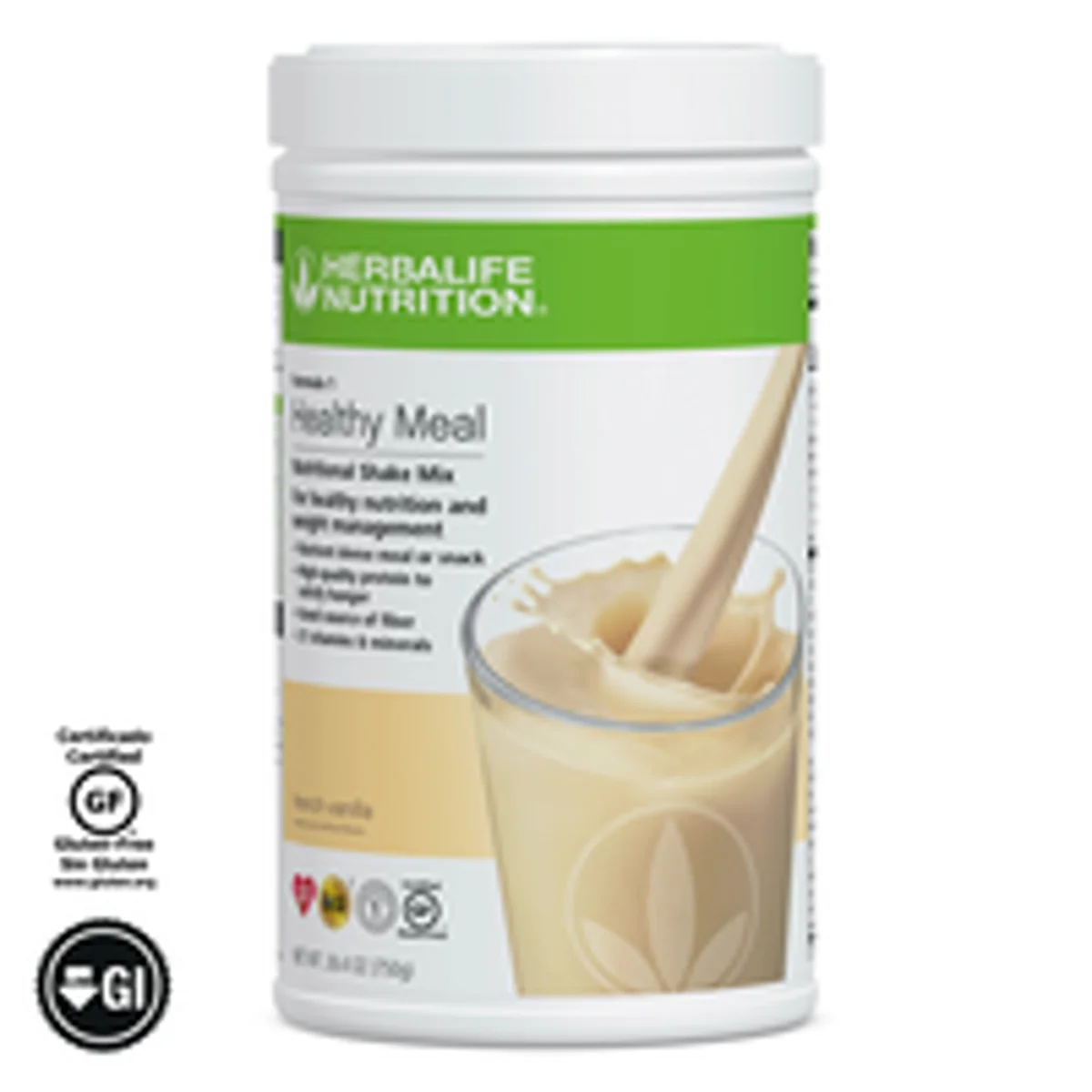
Why Herbalife Formula 1 is the meal replacement we recommend
This guide is written by an independent Herbalife distributor, so it would be dishonest to pretend we do not have a recommendation. Formula 1 is the meal replacement we use ourselves and the one our customers report best results with, for three reasons:
- Track record. Formula 1 has been used in structured weight management programs for over four decades. It is one of the longest-running meal replacement formulas on the market.
- Macronutrient balance. A standard prepared shake delivers about 24 grams of protein with 25 vitamins and minerals — clearing the bar set above.
- Personalized coaching. Buying a shake at a grocery store gives you a shake. Buying through a Herbalife distributor gives you a shake plus someone tracking your progress, adjusting your plan, and answering your questions.
The third point is the one most people undervalue. Weight loss is more about the human standing next to you than the product in your blender.
Mistakes that quietly kill results
Using the shake as an extra, not a replacement
If you drink the shake and eat your usual breakfast, you have added 200–250 calories to your day. Weight will go up, not down. Replacement means replacement.
Skipping meals instead of replacing them
Some people, eager to accelerate results, drop a meal entirely. The body responds with stronger hunger at the next meal — and that next meal usually overshoots. Replacing keeps the rhythm; skipping breaks it.
Picking the cheapest shake on the shelf
Sub-100-calorie diet shakes leave you hungry. Cheap powders are often heavy on filler and light on protein. You do not save money on a product you stop using after two weeks because it does not work.
Expecting weight loss without movement
You will lose weight on a meal replacement program without exercise. You will lose more weight, lose it as fat instead of muscle, and feel better doing it if you walk, lift, or move every day. The shake is one of two levers; movement is the other.
Quitting after two weeks
The first two weeks often produce dramatic scale changes that are mostly water. The trend over month two and three is what tells you if the program works. Plan for 90 days, not for 14.
What to expect, week by week
Week 1: Most people lose 1–3 kg, mostly water and reduced glycogen. Energy can dip on days 3–4 as the body adjusts. Hydration matters most this week.
Weeks 2–4: The pace settles into a true fat-loss range — around 0.5 to 1 kg per week. Hunger feels manageable if the protein and fiber targets are being met.
Months 2–3: The plan becomes a habit. People often stop weighing themselves daily and switch to weekly. Clothes fit differently before the scale changes by much.
When a meal replacement is not the right tool
If you have a clinical eating disorder, are pregnant or breastfeeding, are managing diabetes, kidney disease, or another chronic condition, or are taking medication that interacts with food intake, talk to your doctor before starting a meal replacement program. There is nothing dangerous about meal replacement drinks for healthy adults — but "healthy adult" is a real qualifier, not a phrase to skip past.
Frequently asked questions
- Are meal replacement drinks good for weight loss?
- When chosen carefully and used to replace a meal — not added on top of it — meal replacement drinks can support weight loss in two clear ways. They put a known, controlled amount of calories and protein in front of you, removing decision fatigue. And they tend to be high in protein and balanced micronutrients, so they keep you full while delivering the building blocks your body needs. Results depend on the rest of your day: a meal replacement is a tool, not magic.
- How many meal replacement shakes should I drink a day for weight loss?
- The most common pattern that produces results is one shake at breakfast and one at another meal of your choosing — typically lunch — paired with one balanced cooked meal and two healthy snacks. This keeps total calories controlled while providing 20 to 40 grams of protein from the shakes alone, and it leaves room for real food, vegetables, and social meals.
- Can a meal replacement shake replace dinner?
- Yes, you can use a meal replacement at dinner. Many people find it easier in the morning when they are rushed, and prefer a real cooked meal at night. The key is consistency, not which meal you choose. Pick the meal you most often eat poorly or skip — that is the one a meal replacement will help the most.
- What should I look for in a meal replacement shake?
- Look for a balanced label: roughly 200 to 250 calories per serving, 15 to 25 grams of protein, 20 to 30 percent of daily vitamins and minerals, at least 3 grams of fiber, and low added sugar. The shake should leave you satisfied for three to four hours. If you finish it and feel hungry an hour later, the protein or fiber level is too low for you.
- Will I gain back the weight when I stop using meal replacement shakes?
- Only if you go back to the same eating patterns that caused the weight gain in the first place. Meal replacement shakes do not change your metabolism. They make portion control and protein intake easier. Plenty of people maintain their weight after losing it by keeping one shake a day and applying the eating habits they built during the loss phase to their other meals.
- Are meal replacement shakes safe to drink every day?
- For most healthy adults, yes — using them as part of a varied diet is generally well tolerated. Choose a shake with a complete vitamin and mineral profile so you are not missing nutrients. Do consult your doctor first if you are pregnant, breastfeeding, managing a chronic condition such as diabetes, or taking prescription medication.
- Do meal replacement drinks work for women?
- Yes. The same principles apply to men and women: protein for satiety, controlled calories for the deficit, micronutrients for overall health. Women generally have lower daily calorie needs, so the percentage of daily intake covered by a single shake is slightly higher — that is part of why meal replacements often work well for women trying to lose weight.
- What is the best meal replacement shake for weight loss?
- There is no single best shake. The best one for you is the one with the right protein, fiber, and micronutrient profile that you actually enjoy drinking every day. Taste and routine fit matter as much as the label. Herbalife Formula 1, for example, has been used for decades as part of structured weight management programs precisely because it has many flavors, dissolves quickly, and pairs with personalized coaching from your distributor.
Pulling it together
Meal replacement drinks for weight loss work because they make the right thing the easy thing. Two shakes, one balanced meal, two snacks, water — the structure is simple. The product matters less than your consistency with that structure.
If you are not sure where to start, talk to your independent Herbalife distributor. We will look at your routine, your goals, and your existing diet, and put together a plan that does not require willpower you do not have.
This article is for informational purposes only and is not intended to diagnose, treat, cure, or prevent any disease. Always consult your healthcare provider before starting a new weight management plan, especially if you are pregnant, breastfeeding, taking medication, or living with a chronic condition.
Ready to Start Your Wellness Journey?
Become a Herbalife Preferred Member and enjoy exclusive discounts of up to 25% on all products.
BECOME A PREFERRED MEMBER